Wednesday, April 19, 2006

April 1806

April
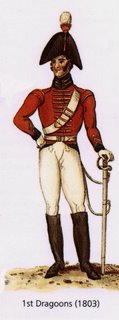
Liverpool – Dublin (1st Dragoons & 1st Hussars)
(Beamish, North Ludlow, History of the King’s German Legion Vol. 1 p90)

9th – set sail from Liverpool (7th Line Battalion)
13th – arrived in Dublin (7th Line Battalion)
(Hering, Johann Fredrich, Journal, Irish Historical Studies, xxv,no. 99 (may 1987))

– 1st Heavy Dragoons arrive Tullamore
– 1st Light Dragoons arrive Gort
(Beamish, North Ludlow, History of the King’s German Legion Vol. 1 p90)

18th Dublin 15 & 16 April
The King’s German Legion, which lately arrived here, marched out of town on Saturday last, for country quarters; and yesterday they were followed by a number of carts laden with baggage belonging to the regiment.
(Freeman's Journal 18th April 1806)

26th Wednesday a division of light dragoons belonging to the King's German Legion, arrived in town (Dublin from ) for Liverpool.
(Freeman's Journal 26th April 1806)

Sunday, April 02, 2006

Thomas Hardy and the KGL

Thomas Hardy wrote a novel called "The Trumpet Major" about the KGL and a short story from his collection "Wessex Tales" called "The Meloncholy Hussar". Both stories can be downloaded as a text or audio file from The Project Gutenberg web site.

March

March 21st
Cork March 17th
On Friday last, 37 sail of transports with the Hanoverian troops on board, passed Crookhaven, and it is supposed put into Bantry Bay, until moderate weather shall enable them to make this port.
(General Advertiser and Limerick Chronicle 21st March 1806)

March 21st
His Majesty's ship Astrea, having under convoy about 40 sail of transports, with the King's German Legion on board arrived in Beerhaven harbout on the 14th inst.
(General Advertiser and Limerick Chronicle 21st March 1806)

March 22nd
Last week the 1st regiment of the King's German Haevy Dragoons marched into Reading, on their route to Liverpool, where it is expected they will embark for Ireland.
(The Waterford Mirror, March 22nd 1806)

March 28th
One battalion of the Hanoverian Legion arrived in Cork on Wednesday, from Monkstown, on their route to Fermoy. Two battalions marched out of that city for Bandon.
(General Advertiser and Limerick Chronicle 28th March 1806)

Monday, March 13, 2006

German Troops in British Service 1791-1817

Anglo German Family History Society

Welcome, fellow members of the society. I hope that you will find this blog of interest to you. Over the past three years I have gathered material about the KBL in Ireland from books and newspapers. 1806 was the year that the KGL made the headlines in the Irish Newspapers. The "Battle of Tullamore" put the troops into the limelight. The skirmish between the KGL and some Irish Militia units on the streets of Tullamore is interesting and caught the attention of everyone including the King. The following five years were relatively quiet for the KGL in Ireland.

If you have any questions email me at spudshow@gmail.com

Monday, March 06, 2006

KGL soldier dies in Cork 29th March 1806

Captain Charles von Kaufmann, 4th Line Battalion died in Monkstown near Cork.
(Beamish, North Ludlow, History of the King’s German Legion Vol. 2 , Appendix 1090)

Sunday, March 05, 2006

Limerick March 4th 1806

The whole of the German Legion - cavalry, infantry, and artillery, lately arrived from the North of Germany, are under orders for Ireland. they are to rendezvous at Portsmouth, where a sufficient number of transports is collecting for their embarkation.

The General Advertiser, (Limerick) March 4th 1806

Sunday, February 26, 2006

February 1806

King's German Legion infantary depart Portsmouth for Ireland.

"Line battalions and two first line brigades depart Portsmouth for Cork"

from Beamish, North Ludlow, History of the King's German Legion Vol. 1, p90

Friday, February 24, 2006

Introduction


Historical background

The hiring of mercenaries in England is not isolated to this period. England has a long tradition of using German and other nationalities to augment the army as required. This tradition dates back to at least the 16th century; at this time Henry VIII employed German Landesknechts for his campaigns in Scotland and France. This tradition continued up to the 19th century.

The House of Hanover ruled Britain from 1714 to 1901. The two countries were jointly ruled until 1837 when Victoria came to power. By Salic Law the ruler of Hanover could not be a woman so succession to Hanover went to Ernest Augustus, Duke of Cumberland and brother of William VI. The King’s and Queen from the House of Hanover were as follows: George I (1714-1727), George II (1727-1760), George III (1760-1820), George IV (1820-1830), William VI (1830-1837), Victoria (1837-1901)

The daughter of George II from his first marriage was married into the royal house in Hessen-Kasell. George III son the Prince of Wales was married to Caroline of Brunswick.

The over-extended empire meant that England was always in need of troops to keep order. The German states proved to be a steady source of troops throughout the rule of the Hanoverians. The German states provided troops because it was income for the state or because the army was disbanded.


King’s German Legion

Napoleon’s forces invaded Hanover in June 1803. In July a treaty was signed. One of the terms of the treaty was that the Hanoverian army was to be disbanded. The soldiers went to England and formed the King’s German Legion (9,000 men). In February of 1806 the KGL started to arrive in Ireland. The last of the troops left Ireland in October of 1811.